
AI agents are generating content for your brand right now. Creative tools are picking logo variants, choosing color palettes, and writing copy in what they think is your voice. They pull this from wherever they can find it — cached web pages, scraped style guides, outdated press kits. You have no control over what they find. You have no way to tell them what not to do.Documentation Index
Fetch the complete documentation index at: https://agenticadvertisingorg-changeset-release-main.mintlify.app/llms.txt
Use this file to discover all available pages before exploring further.
How it works
You publish a single set of brand rules that every AI agent in the advertising ecosystem can read — your logos, colors, tone of voice, and what they must never do. The format is calledbrand.json, and it lives on your domain.
A creative agent gets a brief: “Lunch promotion for Bistro Oranje, two-course menu, EUR 18.50.”
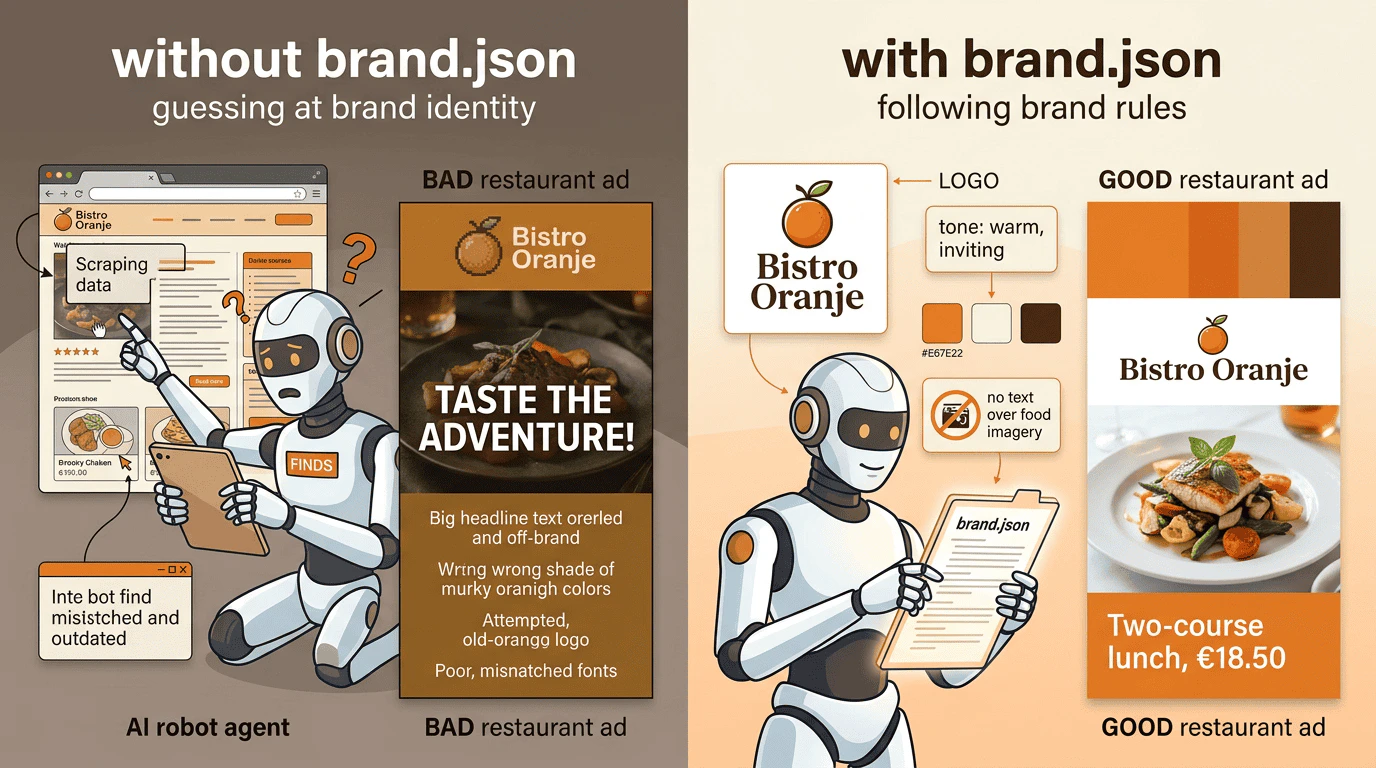
brand.json can — because restrictions are machine-readable rules, not guidelines buried in a PDF.
See what agents know about your brand
Enter any domain on the AgenticAdvertising.org brand registry to see what AI agents find for that brand today. Most brands return nothing — which means agents are guessing. Brands withbrand.json show exactly what agents see.
Two tiers: public and authorized
Not everything belongs in a public file.brand.json handles this with two access levels:
| Level | What it includes | Who sees it |
|---|---|---|
| Public | Name, logo, colors, tagline, basic tone | Any AI agent |
| Authorized | High-res assets, voice synthesis, detailed guidelines | Partners you approve |
One file, many uses
Brands exist in hierarchies — a holding company, its brands, their sub-brands and franchise locations.brand.json handles this: start at any domain and the protocol finds the canonical brand identity. The buy side gets the same structured identity that publishers already have on the sell side.
- License real talent through the same file. Your
brand.jsoncan declare which celebrity likenesses and voices are available, and on what terms. A buyer agent finds talent, negotiates pricing, and gets authorization for AI creative tools — without a single email. Follow the full rights licensing story → - Keep every sub-brand consistent. A franchise domain points to the parent brand in two lines. Every location inherits the full identity — logos, colors, tone, restrictions — with no separate configuration.
- Let the supply chain verify in real time. Before serving an ad, any participant can confirm the talent license is still active and covers the right geography.
Start simple
The smallest usefulbrand.json is just a name and a logo:
Ecosystem support
brand.json feeds into a growing ecosystem of agentic tools that read and act on your brand data:
- Buyer agents that comply with AdCP reference your
brand.jsonduring campaign planning to ensure media buys align with your brand guidelines - Creative agents pull your colors, logos, restrictions, and tone of voice when generating on-brand assets
- The AgenticAdvertising.org registry indexes published
brand.jsonfiles so buyer and seller agents can discover your brand programmatically - Any MCP-compatible AI tool that implements the brand protocol can read your
brand.json— the format is open and not locked to a single platform
brand.json delivers without any additional work on your part.
Go deeper
For brand teams:For advertisers
How to license real talent for AI-generated campaigns.
For rights holders
How AdCP protects and monetizes talent rights.
Rights licensing
Follow a buyer from talent discovery through acquisition and revocation.
brand.json spec
Full technical specification for the file format.
Building a brand agent
Implement a brand agent that serves identity and rights.